Utility linesTrenches & manholesRoad build-upReport as PDF & CSV
InfraCarbon · Carbon accounting for civil works
Carbon footprints for civil works. Traceable to the source.
InfraCarbon calculates the carbon footprint of utility and road projects from a structured project model. Quantities, factors and sources stay traceable.
The video is only loaded from YouTube when you play it. Data is then transferred to YouTube (Google).
Why InfraCarbon
Emissions are decided during design.
In civil works, much of the embodied carbon is decided during design: pipe material, trench build-up, road structure. InfraCarbon makes these decisions visible.
Quantities, factors, sources, assumptions and missing information stay traceable. A missing input is shown as a gap in the result, not as zero.
Road build-up · Trench build-up · Pipe materialSchematic illustration, not to scale
How InfraCarbon works
From project model to a traceable report.
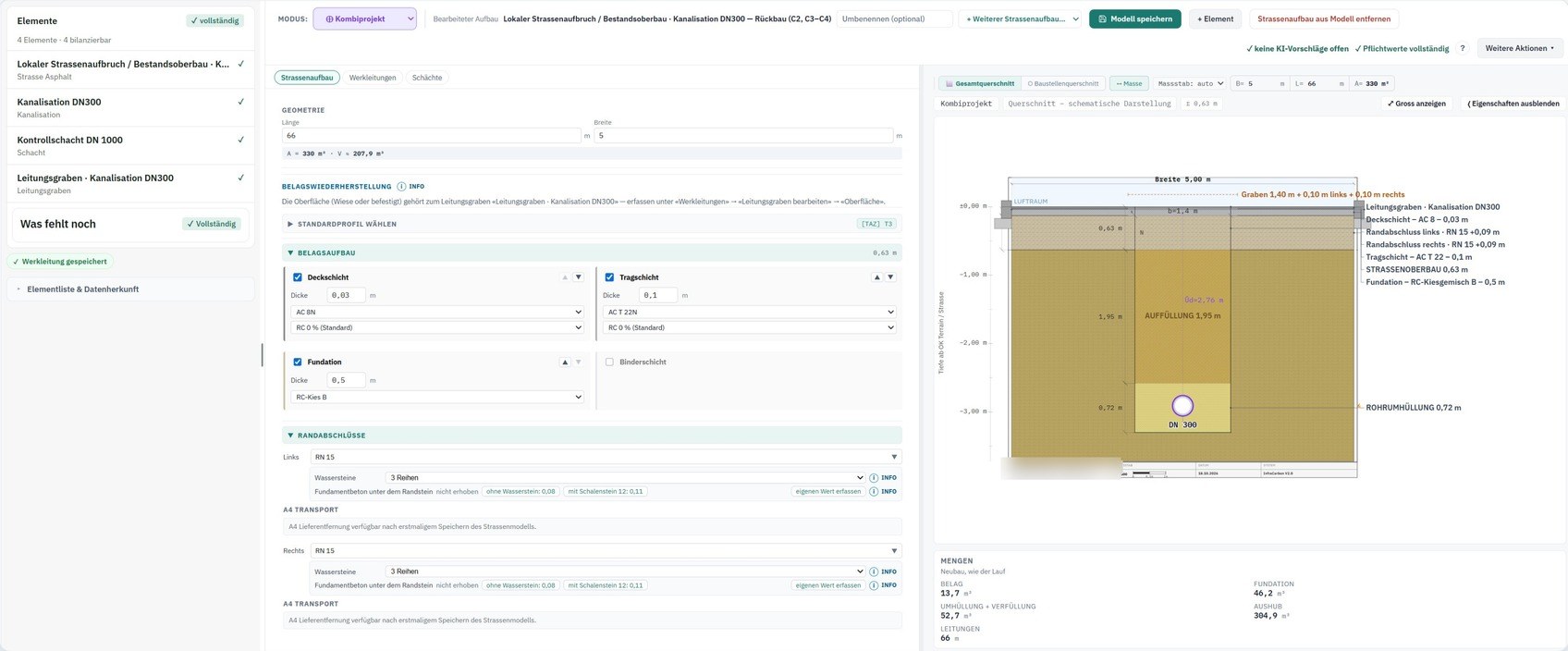
01Model the projectPipes, trenches, manholes and road build-up in one model.
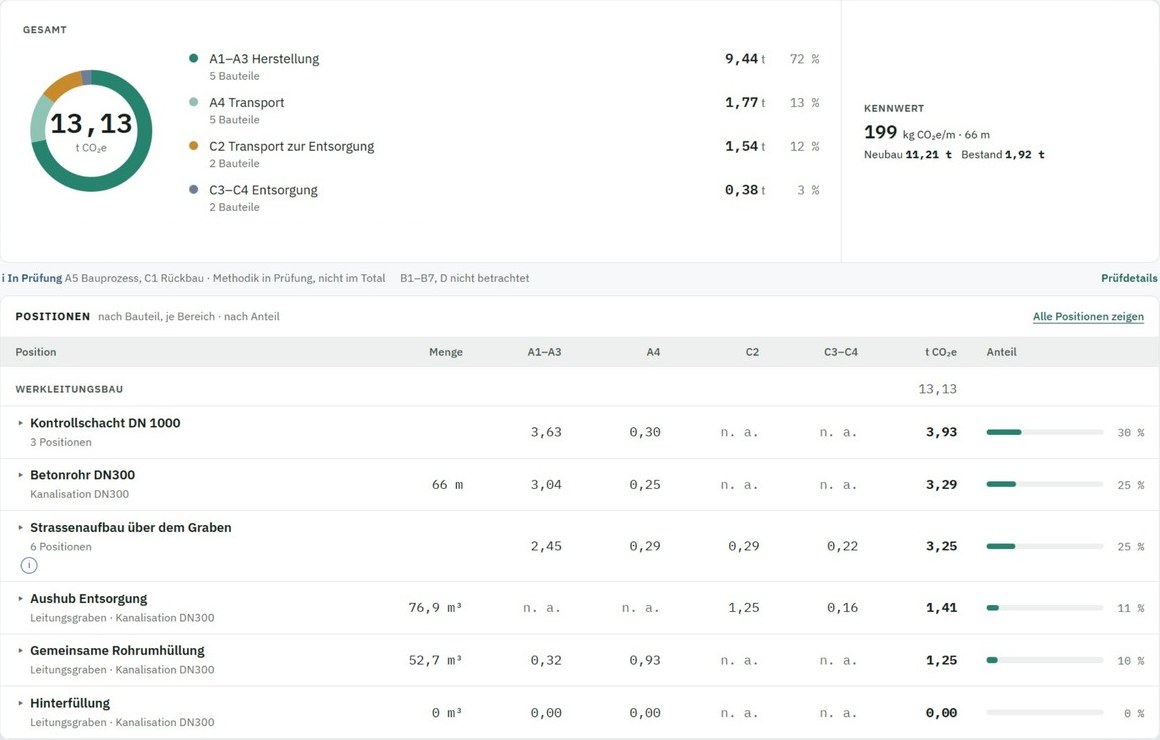
02CalculateProduction, transport and end of life with factors from KBOB V9.0, complemented by further Swiss LCA data where KBOB has no dataset (e.g. road surfacing); every factor with its source, missing inputs shown as gaps.
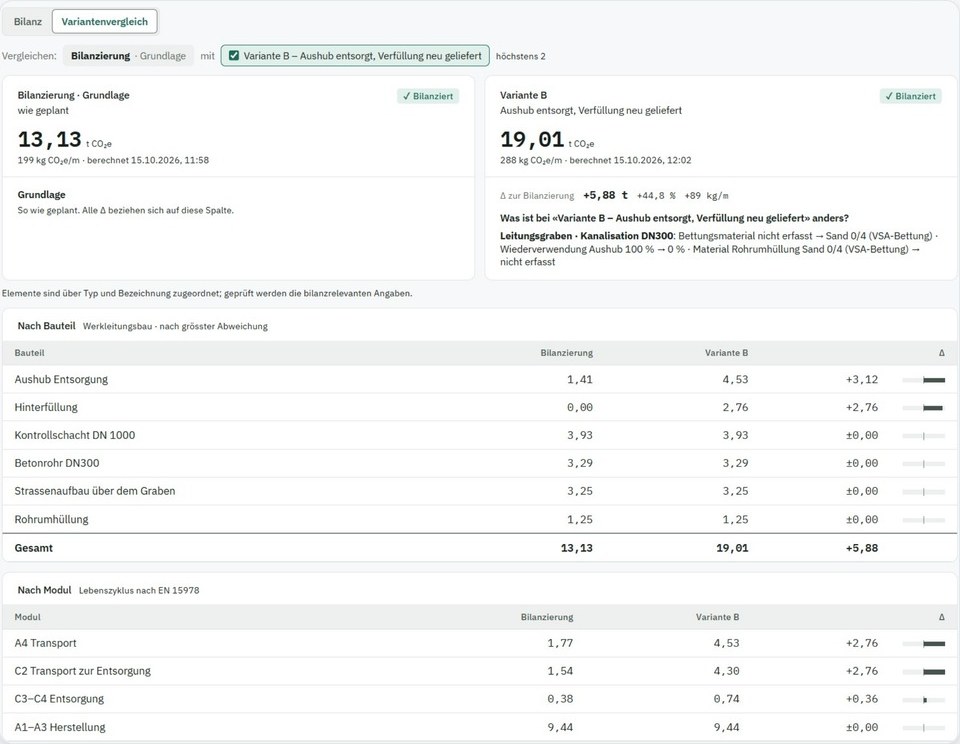
03Compare optionsUp to three variants side by side, e.g. a different pipe material or trench build-up.
04ReportShort or full PDF report with quantities, factors, sources, assumptions and limits; data as CSV.
Covered: production (A1-A3), transport to site (A4) and disposal (C3-C4), plus transport to disposal (C2) where the data source lists it separately.
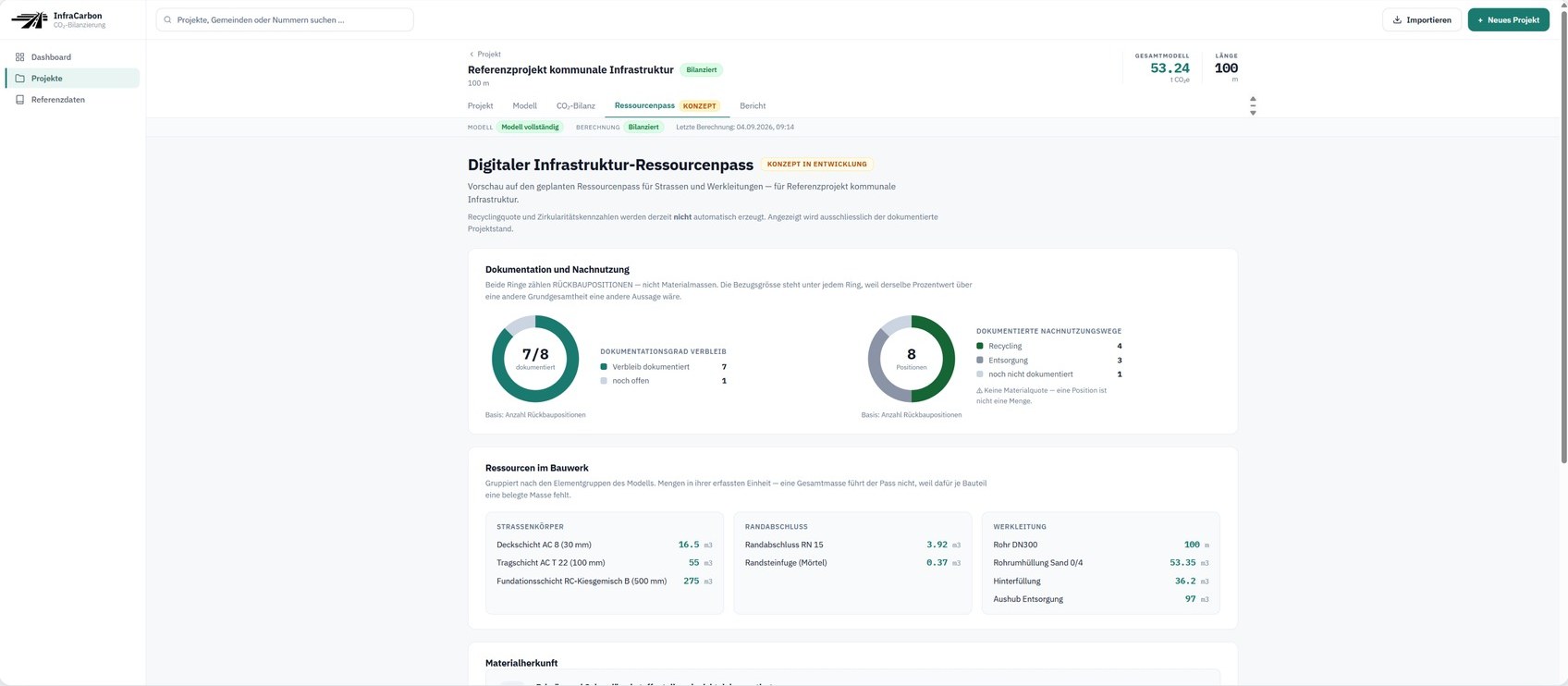
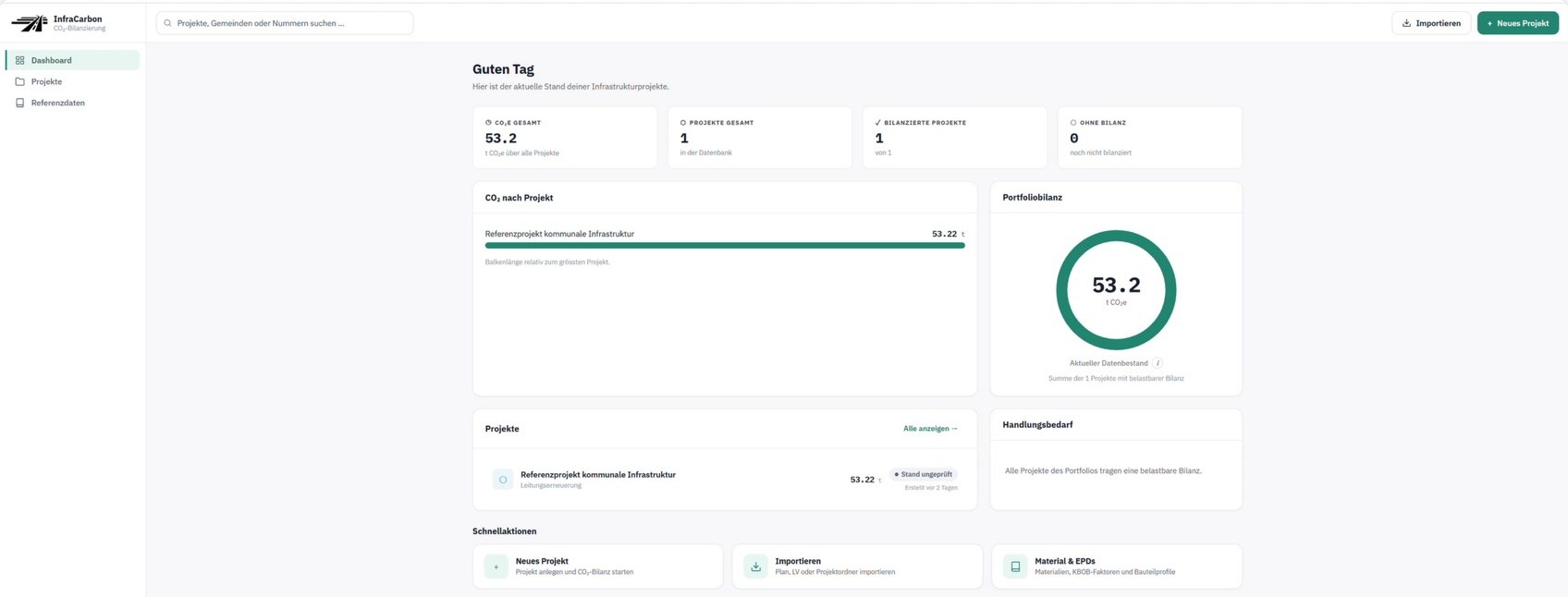
Project model · Road build-up, trench and manholes with a schematic cross-section.Carbon footprint · By life-cycle module, traceable down to the individual position.Option comparison · Differences per component and module.AI-assisted plan reading · Suggestions from drawings, checked and confirmed by an engineer.Resource passport · Materials built in, new or reused, and where they go at demolition.Dashboard · Projects and carbon footprint at a glance.
Screens from the app (October 2026) with an anonymous test project.
Who it is for
For everyone who plans and owns civil infrastructure.
Public works departmentsof cities and municipalities
Engineering firmsin utility and road design
Utility network operators
Municipal drainage utilities
More than a footprint
AI and circular economy.
InfraCarbon combines the carbon footprint with AI-assisted plan reading and the resource passport.
AI-assisted plan reading
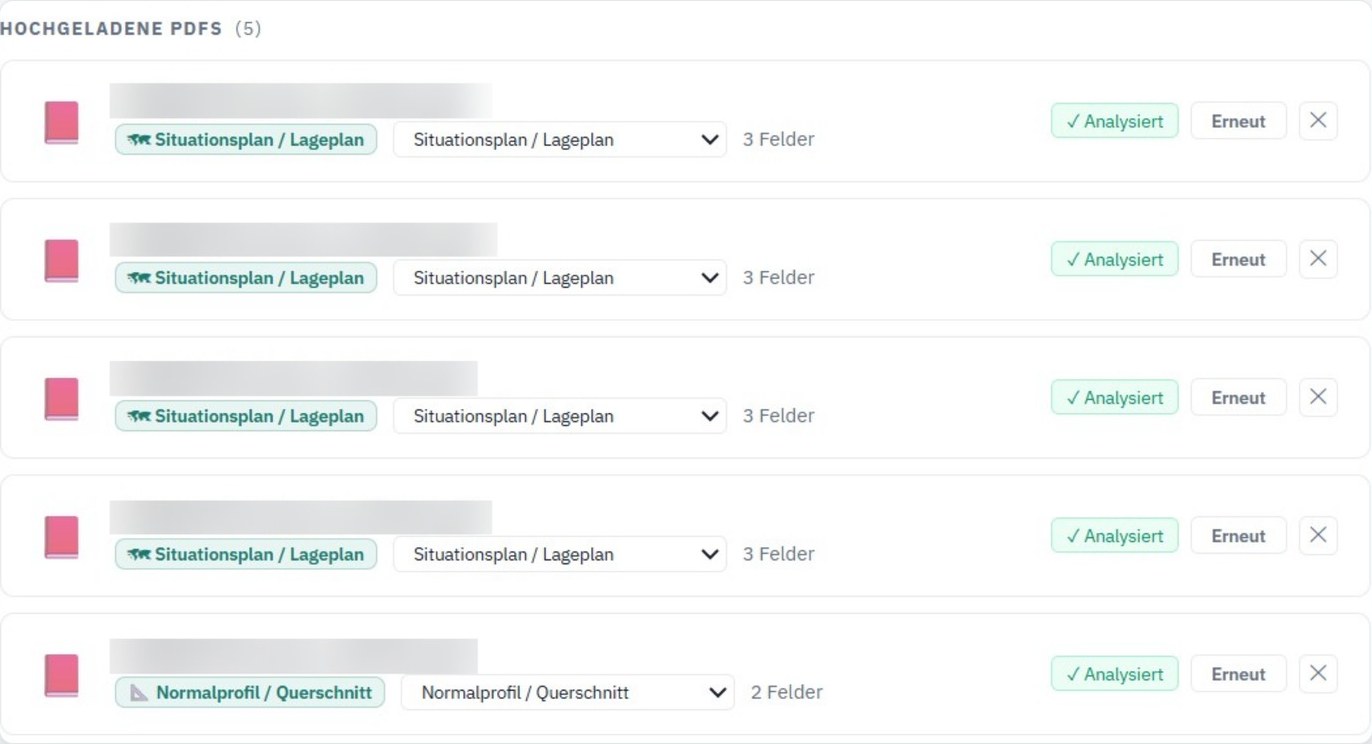
AI-assisted plan reading suggests inputs from drawings, such as pavement layers and their thickness from the typical cross-section. Every suggestion is checked and confirmed by an engineer before it enters the model.
Goal: InfraCarbon will suggest inputs from typical cross-sections, site plans and longitudinal profiles.
Resource passport and circular economy
The resource passport records which materials are built in, whether they are new or reused, and where they go at demolition, as a basis for reuse and recycling. Quantities per component group come straight from the model.
In the footprint
✓On-site reuse of excavated soil can be modelled as a variant and compared with removal and new supply.
✓Recycled building materials can be selected with their own factors.
✓For demolished existing components, the end-of-life route is recorded, e.g. recycling or disposal.
GIS: Our goal is to prepare the resource passport data so that utilities and public works departments can take it into their GIS.
Import of bills of quantitiesTake quantities from the bill of quantities instead of entering them twice.
Construction and demolition phase
Data basis
The factor basis is currently Swiss (KBOB V9.0 and further Swiss LCA data). A German database (ÖKOBAUDAT) is not connected; for projects in Germany this would be a development step.
KBOB V9.0Swiss LCA dataEvery factor with its source
We prepare the carbon footprint of your civil works project with InfraCarbon.